

A Nontoxic Home in a Toxic World
A polymer engineer's perspective on reducing plastic in the home. It's a bit science-y, but hang with me. (this will be a multi-part series)

Before I dive in, you may be wondering what a polymer engineer is. I’ve been asked that question pretty frequently since I graduated college. In it’s simplest form, it’s a lot of education on plastic. Polymers can be found in nature, but most of the time they are man made materials like: polyester, PTFE, kevlar, nylon and more. You’ve most likely encountered one those on a daily basis, especially if you wear leggings or activewear.
Why temperature really matters.
I want to be very clear on two things: plastic has it’s place and it’s also impossible to have a perfectly nontoxic kitchen in today’s world.
My hope is that this article helps educate and empower you to make choices that work for your family.
A very very basic lesson on plastic. All synthetic materials have TWO critical temperatures that are tested: the glass transition temperature and the melting temperature. These two temperatures are VERY important in how you use different materials in your home.
Most products will list the melting temperature or say “microwave safe” or “dishwasher safe” indicating that they won’t MELT at those temperatures, however, you need to be concerned about glass transition temperatures of plastics.
What happens at the glass transition temperature? It’s the temperature range before a material melts but the physical properties start changing and the material can start to become amorphous.
Why does this matter? Well, HEAT is the biggest enemy to plastics in the home. Applying heat to plastics is what’s going to cause it to break down and be more toxic even before the melting temperature. The other weird thing about plastic is it can never go away. It will just break down into smaller and smaller pieces if it’s not recycled. (But not every plastic can be recycled! Think: tires)
Let’s talk about plasticizers. I’m sure you’ve bought something advertised as “BPA free.” What is bisphenol a and why would you use it? BPA is a plasticizer. Plasticizers are used to allow a plastic to be easier to mold making the manufacturing process easier and faster. It changes the properties of the materials used.
The melting point of BPA 316.4 degree Fahrenheit or 158 degrees Celsius and the glass transition is a low 104 degrees Fahrenheit or 40 degrees Celsius. A summer day in Texas or Arizona can easily get over that temperature. Think about the containers transporting items like bottled water that will heat up well above those temperatures. Another thing to think about is food coming out of the oven or stovetop is easily over that temperature as well even if you aren’t cooking it.
I hope you can see that looking at these critical temperatures for plastic materials make it hard to food warm or hot food on to them. Just entering into the glass transition temperature, you’re going to start to see a breakdown of plastic.
Common types of plastic and how to find them.
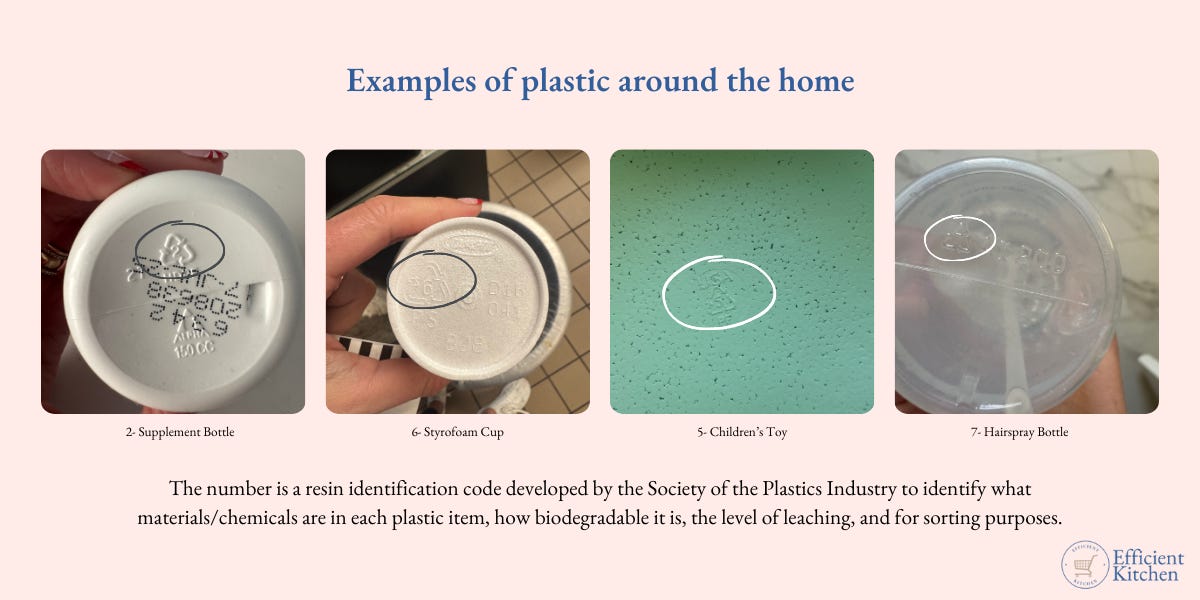
In general, plastic items have a number code on the bottom of them to identify what materials or chemicals are in each plastic item. It’s generally for recycling purposes, but can be helpful for you as the consumer on if you want that material in your home. Below is a very simplified explanation of the codes 1-7.
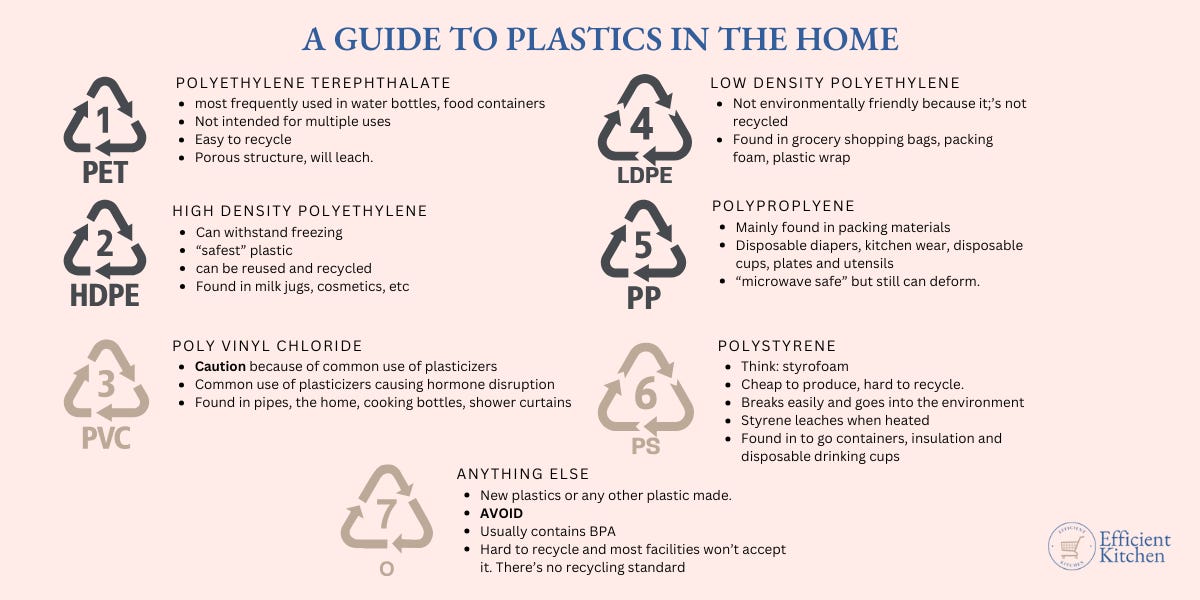
Numbers two, four, and five are probably the most common that you will find in your home. Those are the materials used in packaging material the most. It is pretty much impossible to avoid plastic with your supplements, makeup containers (because sometimes even the refill is plastic), some children’s toys (even if you avoid plastic think about markers and drawing supplies!), and most takeout containers or paper plates have plastic lining.
Numbers three, six, and seven should be avoided as much as possible. PVC is a hard one to avoid because a lot of the construction materials in the home contain PVC. Having PVC pipes though shouldn’t make you freak out. A decent water filter can really help with that one.
Let’s look at nonstick cookware and bakeware.
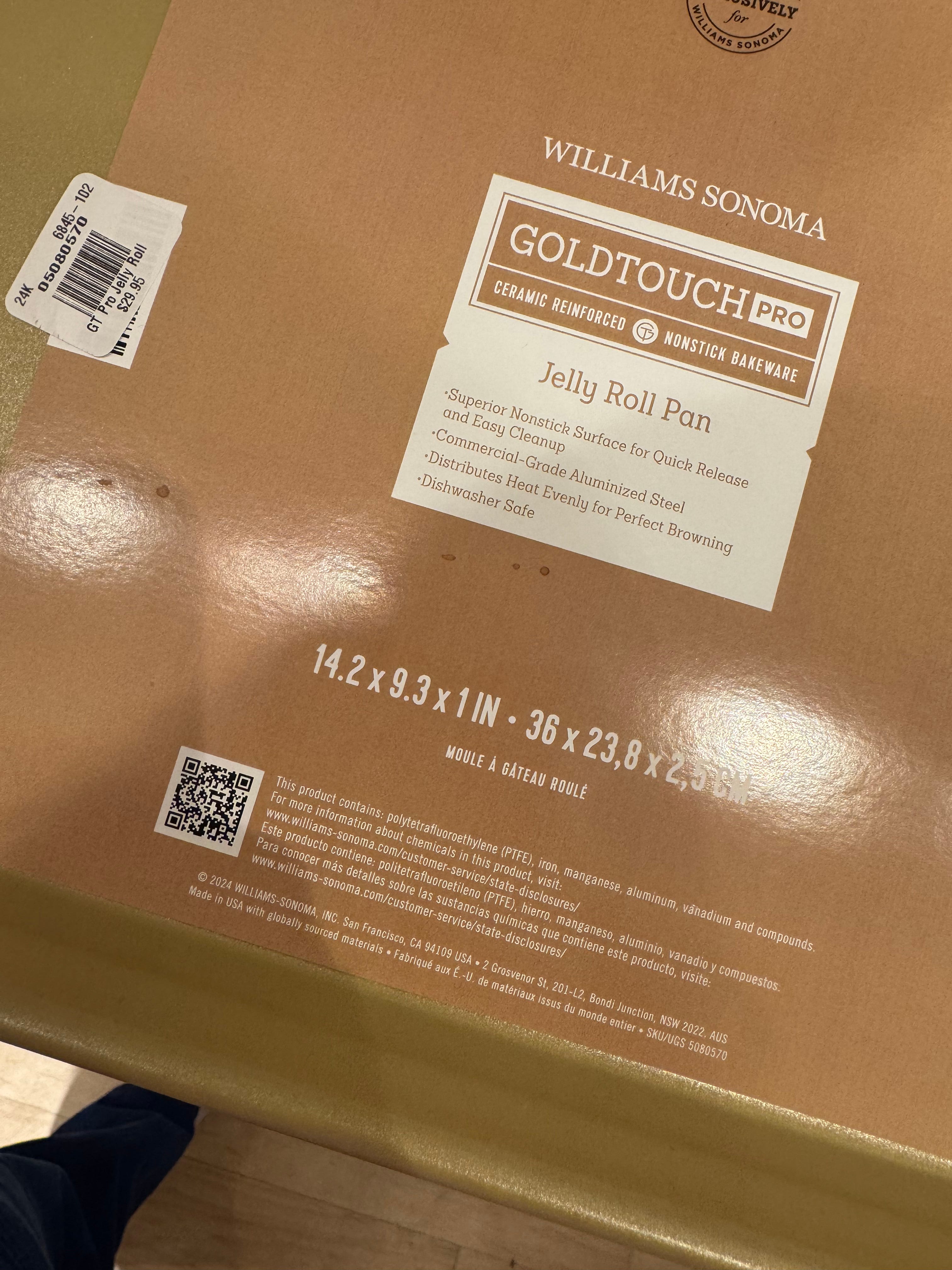
I get asked about non toxic cookware all the time. I went to William Sonoma to look at their options because I have the Traditional Touch bakeware pieces (no coating) and they have held up really well for 10 years.
Their “GoldTouch Pro” is their “high end” cookware. I was not very “crunchy” when I registered for items in my home but I did avoid this one when they tried hard to sell me on it. (If you feel badly, I used Melamine dishes for years as our only dishes.)
The label on the GoldTouch pro says it contains “PTFE, iron, manganese, aluminum, vanadium, and compounds.”
Let’s go back to the transition temperature I talked about earlier. The glass transition temperature is up for debate. It is marked as seeing changes as low as 30 degrees Celsius/86 degree Fahrenheit. Most of your baking is going to be around 350 degrees Fahrenheit give or take. This means that you could see a breakdown of the coating EVERY SINGLE TIME YOU USE IT. Have you noticed that you have to replace your nonstick cookware every so often?? It does not last. Until I switched to ceramic coated cast iron, I was replacing my nonstick pan every two years with heavy usage.
Well is plastic really that bad?
Yes, it can be. Certain plastics are KNOWN carcinogens and hormone disruptors. I don’t know how they are allowed near our food with that knowledge, but they are. Some easy ways to reduce your exposure are:
using your own cup instead of styrofoam or paper coffee cups (the lining is the problem)
opt for glass food storage as much as possible
buy canned goods that are BPA free
Use recyclable make up containers
So what are my options?
One place I’m personally okay with plastic is the freezer. Ideally I would use silicone or glass for storage but it’s more costly and bulky. Glass gets more brittle in the freezer and it’s hard to get the food out. I do use Ziploc freezer bags and they can be reused for a few uses, with the exception of marinades or meat. Remember- plastic is porous and that’s one of the problems with it.
Stay tuned for part two where I will break down the pros and cons of the different materials to use in the kitchen. Ceramic, cast iron, stainless steel, glass and wood all have different functions. I will break them all down in my next post. Don’t hesitate to drop questions in the comments below!
references:
https://pmc.ncbi.nlm.nih.gov/articles/PMC9885170/ Interesting article on plastics and hormones.
https://www.whatsinsidescjohnson.com/us/en/brands/ziploc/ziploc-brand-freezer-bags#:~:text=It%20is%20part%20of%20the,flexibility%20for%20different%20bag%20types. (You can look up the materials of any SC Johnson product on this site! Very helpful! I do use Ziploc Freezer bags personally.)